He certainly deserves more than just this brief posting, but I couldn't let the 100th anniversary of Vincent Price's birth go by without commemoration.
One of my favorite actors--and one of the greats from the second generation of horror movie icons, among such company as Peter Cushing and Christopher Lee (also born on May 27th). Price was born on this date in St. Louis, Missouri in 1911.
Cinema St. Louis has been celebrating this past week with their Vincentennial: exhibits of artifacts, artwork, lectures and presentations, and screenings of 20 Price films. Check out the program guide here.
I couldn't make it to the Vincentennial, but I could probably host a reasonable facsimile here in the Kaiju Lair with our collection of Price DVDs. I'll try to spin one over the holiday weekend--or check out a movie I don't have via streaming Netflix.
For the next few campaign wrap-up postings, I'd like to show some photos taken during the game. I'll also include scans of some maps and my notes. See the first part of my Shadows over Freeport wrap-up here.
March 2008: My gaming area after the character creation session and before the "official" first session. I added a four-foor table to the end where I sit to allow more room for the players and my notes and other items.
May 2009: The party fights their way through degenerate serpent people on the fourth level of the sunken Temple of Yig, buried under the volcanic rock of Mount A'Val. This location was taken from the module Madness in Freeport, the final chapter of The Freeport Trilogy.
Down to the fifth level of the Temple of Yig.
At the base of the temple, the sixth level, the group splits up to fight more degenerate serpent people in the corridor while others take on the awakened Avatar of Yig who had been sleeping in the sacrificial pit.
Another view of the battle. The worm miniature shown here is far below scale (so is the map); the Avatar was closer to 70 feet long. The d10 in the background marked the location of the only intact egg found in the hatchery.
1963 was a good year for Ray Harryhausen. One of his most popular films, Jason and the Argonauts, was in general release; he married his wife Diana; and pre-production started on his next film, First Men in the Moon.
In the late 1950s and 60s, studios produced many films that we could call "Victorian science-fiction adventure" -- Journey to the Center of the Earth, The Time Machine and 20,000 Leagues under the Sea are some examples. The advance of special effects techniques and widescreen Technicolor processes allowed filmmakers to realize these fantastic worlds on the screen in a realistic way as never before.
First Men in the Moon was a departure from other science fiction films of the era. Rather than an invasion of Earth by aliens, it documents the exploration of an alien civilization by human beings. Harryhausen was a fan of H.G. Wells' book and had wanted to bring it to the screen for some time (the last film production having been made in 1919) but was unable to convince his partner, producer Charles Schneer, that it could be done in a way that modern audiences would believe.
That changed when he mentioned the idea to British screenwriter Nigel Kneale (creator of the character Professor Quatermass). Kneale proposed the idea of a wrap-around story, in which a modern UN lunar mission finds a tattered Union Jack on the surface and a note claiming the Moon for Queen Victoria. Schneer signed Kneale on to co-write the screenplay.
Unlike most Harryhausen films there are only three instances of stop-motion animation: the caterpillar-like "mooncalf", a Selenite technician and the Grand Lunar, the leader of the Selenites. The majority of visual effects are models, camera effects, forced perspective, and optical-printing layers of mattes together. The majority of the insect-like Selenites are portrayed by children in costume (the same technique used later in The Green Slime).
First Men in the Moon is a fun movie. It's very much in the vein of other family adventure films of the era like Journey to the Center of the Earth. I don't recall ever seeing First Men... on TV growing up, certainly not as often as Journey... was shown.
I watched the 2002 DVD release. The print used for the DVD looks good, and is presented in anamorphic widescreen. The DVD also includes a photo gallery, trailers for First Men... and two Harryhausen Sinbad films, a three-minute featurette on the optical print/stop-motion process Dynamation, and the hour-long bio The Harryhausen Chronicles.
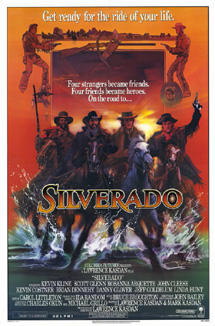
I had not seen Silverado until this past week. It was popular at the time of its release, particularly among the gaming and movie geeks I knew at the time. I just never got around to seeing it at the theater or on video.
After surviving a pre-credits ambush, ex-con Emmett (Scott Glenn) meets Paden (Kevin Kline) in the desert, left for dead by the bandits who stole his horse, hat and gun. They catch up with the bandits at a cavalry outpost, where they also encounter Cobb (Brian Dennehy), who used to run with Paden in earlier lawless days. Cobb offers Paden work, which he refuses. Emmett and Paden continue on to Turley to find Emmett's younger brother Jake (Kevin Costner) so they can both travel on to California. While in Turley they meet Mal (Danny Glover), an African-American gunfighter who left work in the stockyards of Chicago to find his family. Mal is thrown out of town by the sheriff (John Cleese) and the other three escape after busting Jake out of jail. The four of them find their way to Silverado where the son of the cattle baron Emmett killed in self-defense and Sheriff Cobb (something he forgot to mention to Paden earlier) control the town with intimidation and violence.
Lawrence Kasdan directed, produced and co-wrote the movie along with his brother. I wonder if there's a parallel between the Kasdan brothers and the characters of brothers Jake and Emmett: which one is the solid, steady loner, and which is the talented but wild and undisciplined one?
Kasdan had struck gold with several hit films before this. He completed the screenplay of The Empire Strikes Back with Leigh Brackett, wrote and directed Body Heat, wrote Raiders of the Lost Ark and Return of the Jedi, and wrote, directed and produced The Big Chill.
There seem to be two schools of thought among movie buffs concerning Silverado. One viewpoint holds that Kasdan works too close to the old line in the Western genre. The movie uses many of the classic Western movie cliches but doesn't do anything new with them. The second opinion is that it's Kasdan's adherence to these tropes that are its strength. Silverado is really one of the Last Great Westerns of the classic Hollywood studio era. There wouldn't be another major Western until Clint Eastwood's Unforgiven in 1992, which would then usher in a new round of Westerns including Tombstone and Kasdan's Wyatt Earp (again with Costner) in 1993.
I agree with the second viewpoint. It does use many classic Western tropes we have seen before but they are used here in a new way. Not in the revisionist way that we saw in Westerns of the 1970s--many of the Hollywood Westerns in the 1970s portrayed the End of the West as a historical idea but also as the End of the Hollywood System and the rise of independent filmmakers, heavily influenced by the spaghetti Westerns of Italy and Spain.
Silverado is a return to the ideas of the '40s, '50s and early '60s Hollywood Western. It's idealistic but not sappy, fun but not comedic. The events of the film and the obstacles put in the paths of our heroes are taken seriously by the characters (and by the film itself) even though there is still an optimistic tone that is reminiscent of the best classic Westerns. The difference is that here Kasdan is using a more modern method of storytelling that really became standard in Hollywood films at the end of the Eighties. We have multiple heroes with multiple storylines going at once and we see how these threads spread out and converge again. Kasdan uses classic filming shots and camera setups with a more modern story and editing style to create a new "old" Western. I understand the argument of its detractors, but the film has such heart and is such fun to watch. The four lead actors--most of them fairly early in their careers--really shine and work well together. I especially enjoy the fun and youthful Kevin Costner seen here, in contrast to the more serious demeanor he displays in much of his later work.
Silverado is also notable for the construction of the largest standing Western town set up to that time (later destroyed by fire during the filming of Will Smith's Wild Wild West, also co-staring Kevin Kline) which was re-dressed to portray both the towns of Turley and Silverado.
I watched Silverado using Instant Netflix. The menu screen suggests that it's in HD, although I couldn't tell if Netflix used a high-def transfer or the DVD transfer. The film is also available on 2-disc DVD and Blu-ray with several great extras, including a commentary track by Western historians.
It's been a little over two weeks since our Freeport campaign finished up. Freeport is Green Ronin's fantasy/pirates/Lovecraftian horror setting. The main book is systemless and GR has released or licensed rules companions for most of the major systems. We used GR's True20 system.
In total, we had sixty game sessions over three years and two months of real time. The final three sessions involved the party fighting a group of skeletal pirates at the bottom of the ocean, exploring a pyramid temple of serpent people on a sunken island while looking for the lost treasure of the legendary Captain Francisco, and fighting Deep Ones and their god who was imprisoned within the temple.
I'm still putting together my thoughts about the campaign. I think everyone enjoyed it. I often second-guess my game-mastering style, so I try to look over how the sessions went and what things I can improve on for the future.
Some ideas so far:
Talking with my hands: I tend to use my hands quite a bit when I talk. I hope that it isn't too distracting, but I'd like to cut down on it.
Speaking about the environment from my perspective: During this campaign, I noticed myself doing this and I tried not to make it a habit. When I describe a scene or location, I imagine it from the players' perspective and try to describe it as such. Unfortunately, I sometimes use directions from my point-of-view; that is, if I describe a tunnel to the left of the party, I would talk as if it was on my left--the opposite viewpoint of the party--which could get confusing for them. Perhaps even worse were the couple of times that I drew out maps on our miniatures grid mat facing me instead of the players.
Forgetting to use NPCs in combat: Often I found that I would forget about the allied NPCs that were with the party during combat. Usually I would have the NPCs take their actions before any of the group's adversaries. Missing their turns was never a determining factor in any of the combats so it wasn't an important issue but it could have lead to more interesting scenes. In my defense, one of my general guidelines is that NPC allies should never upstage the player characters.
Spending time looking up obscure rules: Part of this campaign's purpose was to try out True20, kick the tires and see how it works under actual play conditions. I'm still thinking about that and how it went. What I'd like to avoid is spending valuable time checking rules. At its heart, True20 is simple: roll a d20, add an attribute, and roll against a target number. With the additions of the Companion book, the Freeport Companion, the Bestiary, and the Handbooks for each of the three classes, there were some occasions where it became necessary to look something up. I was often torn between wanting to get the rules right and making a temporary ruling so that play would not slow down.
Not enough detail vs. too much detail: This is a tricky one. I tried to add enough detail to descriptions to make the campaign world seem real but without overwhelming the players with detail that wasn't significant to the game. I can recall describing some less-important NPCs with only the barest details.
These are only a few items that I've been thinking about. I'm sure I'll come back to this later. The next post about the Freeport campaign will have some photos of miniatures, maps and terrain from various important scenes. I also want to post some scans of my notes, charts and other notebook jottings.
I've been meaning to do this for some time now: I converted the majority of static links on my gaming blog list to an auto-updating blogroll. You'll find it at the bottom of the left sidebar. It's not complete so I'll be adding more as time goes on.
To new (and current) followers of the blog, thank you! I hope you find what I post here interesting and useful.
Reptilicus is a bizarre little movie. It's no wonder that clips of the monster were used as stock footage during the more chaotic moments on The Monkees' television show. Being the only Danish giant monster film, it was quite popular in its home country. I do remember it being shown on TV quite a bit when I was a kid, although I only remember seeing it fully once or twice. I remember it mostly from those clips on The Monkees.
High about the Arctic Circle (in a sunny tree-filled forest), a group of copper miners collect core samples from below the permafrost. The drill bit comes back up with thick leathery flesh caught in the threads... and fresh blood. Scientists from the Danmarks Aquarium are sent to inspect and dig up the fossil--or whatever is down there. They find part of a giant prehistoric reptile's tail. Keeping the sample frozen, they ship it back to the aquarium for study. The freezer door is left open one night, and it's discovered that the thawing tail is still alive and regenerating. Later, two UN representatives join them: a stern US brigadier general and a beautiful female scientist from UNESCO. Just in time, too, as the combination of increased nutrient flow and an electrical storm cause the regeneration to rapidly accelerate...
The real-life drama behind the making of the film is perhaps more entertaining than the movie itself. American producer/director Sid Pink developed the idea for the story, and co-wrote the screenplay with novelist and screenwriter Ib Melchior (who was born in Copenhagen). Pink set up production for the film in and around Copenhagen. The original version was filmed in the Danish language by Danish director Poul Bang and released there in 1961.
Pink directed the English version for American-International Pictures--twice. The first English version was filmed with many of the same actors, none of whom spoke English. They recited their lines in English phonetically. The execs at AIP, particularly Sam Arkoff, hated it. They had the film re-cut, with American voice actors dubbing the lines in English. They still had to match the stilted mouth movements of the Danish actors, however.
Several scenes and parts of scenes were cut for the AIP release, including the infamous Reptilicus flying scene (or this link). It's set at night so the crude nature of the effects work isn't as obvious. Compared to the rest of the creature effects in the movie, the flying scene really isn't that bad. The model for Reptilicus itself appears to be a marionette puppet.
One aspect of the film that was kept is the inclusion of popular Danish comedian Dirch Passer. He plays the night watchman hired on to keep an eye on the frozen Reptilicus tail in the aquarium. His scenes are played for laughs, of course. The officer he talks to at the police station was one of his frequent comedy collaborators.
For the AIP release, Reptilicus' green acid slime spit was added. This takes the form of hand-drawn animation added into scenes where the monster attacks crowds at the beach or on the streets of Copenhagen. Apparently many, many locals were used for the crowd scenes, and members of the Danish military and their equipment were provided for the films use. These scenes and the stock footage are carefully edited together. It's really not bad at all for a lower-budget production. And, as previously noted, it was a source of pride for the Danish people.
Before the monster attacks, the American general accompanies his Danish counterpart and the UNESCO representative for a drive and a night on the town. This part seems almost as if someone slipped a tour package film into this monster movie. For someone who seemed to hate his new assignment at first, the brigadier general now appears to know all about the history, architecture and public sculpture of Copenhagen.
I watched the out-of-print Midnite Movies DVD from MGM. The print used is in decent shape, considering the history of the film. The film was shot in 1.37:1 35mm, so the DVD is full screen and non-anamorphic. You can also watch the 10-minute version. For more details, I recommend the reviews and background at Jabootu's Bad Movie Dimension or The Monster Shack. It's goofy fun, and really inspires the viewer to provide an ongoing MST3K-style commentary.
Update 2: Shout Factory released a four-movie Sci-Fi Classics disc in September 2013 including Reptilicus, presumably using the same print as the MGM disc.
Update 3: Scream Factory, a sub-label of Shout Factory, will release a Blu-ray double-feature of Tentacles (1977, also previously released in the Midnite Movies series) and Reptilicus on June 16th, 2015.
Update 4: Reptilicus is the experiment for the first episode of Mystery Science Theater 3000's 11th season, now streaming on Netflix (listed as Season One).
The first theatrical trailer for Conan was released into the wilds of the internet yesterday. I'll have more to say about it later after I've watched it a few more times. I will say that, based on just one viewing, I'm slightly more encouraged about the film than before.
There's some talk that this trailer will be attached to Thor when it's released this weekend. If not, it should be.
Loud speakers warning: the video starts playing as soon as the page loads up.
Joseph Kuo was one of the leading independent directors of Hong Kong kung fu movies. Mystery of Chess Boxing, Blazing Temple and 7 Grandmasters are considered his best work. Before those films, one of his early successes was 18 Bronzemen.
Set during the Manchu invasion, 18 Bronzemen opens with an attack on the household of a notable Ming general. The general is killed, and his infant son Shao Long is passed into a family of Ming loyalists, where he begins kung fu training and brutal beatings to give him strength. The Manchu continue to terrorize the surviving Mings, and so the boy is sent to the safety of the Shaolin Temple for further training. Before his training can be considered complete he must pass through the 36 Chambers and face the 18 Bronzemen, or die in the attempt...
This was one of several kung fu films to focus on the Shaolin Temple and the 36 Chambers of testing in particular, two years before Lau Kar-Leung's famous The 36th Chamber of Shaolin. The success of this film would lead to two sequels (well, same actors, different characters...): Return of the 18 Bronzemen and the aforementioned Blazing Temple (8 Masters). Carter Wong (Thunder from Big Trouble in Little China) plays the "big brother" role, the serious student who helps the bumbling Shao Long through his training.
For an independent film of the time, the production quality is fairly high. The sets of the Temple, especially the training areas, are impressive. The town setting must have been filmed at one of the studio backlots, but is very effective, and the teahouse fight scene is really good. Carter Wong's fight scenes are the highlight of the film.
One lingering question: What are the 18 Bronzemen? Automatons? Shaolin masters in gold paint?
The first two-thirds of the movie--involving the Temple and the training--work the best. Once they leave, the film starts to fall apart. It's almost as if it's rushing to move the story along. The editing of some scenes can leave the viewer wondering who people are and what is going on. I think that's a problem both with the dubbing and with cultural differences. When Polly Shang first appears, it is implied that she is disguised as a man and Shao Long is fooled by the disguise, although to the viewer it's obvious that she isn't. I got it, that it's a cultural convention for these types of stories, but the casual viewer might take it literally. There's also one of the worst jump-cuts I've seen in a kung fu film, where the fight between our heroes and the Manchu warlord goes from a city street to a mountain valley in one cut.
Odd story and editing choices aside, the film is worth seeing as a great example of the independent kung fu films outside the major studios (i.e., Shaw Brothers) and the early "old-school" productions.
I watched the Tai Seng/Mei Ah DVD released in 2002 with Mandarin dialogue and English subtitles. It can also be viewed in 10-minute parts on YouTube.
I haven't been keeping up with DVD release news for about five weeks now, so -- wouldn't you know it? -- that's the time when there are some big announcements.
Hammer fans can now get the DVD of The Creatures the World Forgot from Sony's Screen Classics Manufactured-On-Demand series. The last of the three prehistoric epics from Hammer (including One Million Years B.C. and When Dinosaurs Ruled the Earth), Creatures... is notable for the near-total lack of dialogue. The story is told through the actions of the characters (no stop-motion dinosaurs, either). It was released on VHS years ago but has only been available recently as a download or streaming rental through Amazon Video on Demand.
The Warner Archive continues rolling out great films from the vault through their MOD program. One of the latest releases is the Rankin/Bass-produced film The Last Dinosaur, which has special effects by Tsuburaya Productions. From the IMDB:
Science has announced the discovery of a lost land hidden inside the warm pocket of a dormant volcano under the polar ice cap. Masten Thrust, a billionaire oil tycoon and big-game hunter, is recruited to lead a team there to study the last living dinosaurs. Upon arriving, Thrust and his team find that the hidden world is populated with both dinosaurs and prehistoric humans. While the humans give the explorers a fair bit of trouble, the real danger is the hungry tyrannosaur intent on making lunch out of the Great White Hunter and his crew.
This was originally planned as a theatrical release but was shown in the US as a TV-movie. I only remember vague mentions of this; I don't believe I ever saw it on TV.
Speaking of MOD discs, Sony has made an agreement with Warner Brothers to sell their Screen Classics on Demand from the Warner Archive web store. It makes sense -- Warner Archive has become the MOD powerhouse among the studios and (even better) Warner Archive has regular sales and coupon codes. MGM's own foray into the made-on-demand business had some false starts with Amazon, although it appears that MGM MOD discs are being made available now through Screen Archives Entertainment, the fine folks who bring us Film Score Monthly limited edition soundtrack CDs and other treasures.
Legend Films has released various movies from the Paramount back-catalog, and on May 3rd we get an excellent British horror treat: a Blu-ray double-feature of Hammer's The Man who Could Cheat Death and Amicus Productions' The Skull. Legend released these two on DVD previously. Severin Films has Amicus' The House That Dripped Blood in prep for eventual release.
Public domain-content provider Film Chest has restored and released Roger Corman's 1963 film The Terror as a Blu-ray/DVD combo pack. The movie was made in a matter of days using the magnificent sets left over from Corman's Poe film The Raven, and extra time left on Boris Karloff's contract. It's impressive considering the circumstances of the shoot. I have a soft spot for The Terror, as I remember it being a staple of Saturday afternoons as a kid. If one of the Corman Poe films were being shown, it was likely to be The Terror -- probably due to its public-domain status. With this high-def release it gets the restoration it deserves.
Finally, there has been some buzz about an official DVD release of Godzilla vs. Megalon. As with The Terror, Megalon has been a mainstay of public-domain releases. Nearly every PD video company put out a cheap VHS tape during the '80s and '90s. So far it appears to be speculation. I'm sure there is more to the story, and like many others I hope we see an official release soon.
We learned today (thanks to Norbert) that Elisabeth Sladen, who portrayed Sarah Jane Smith on Doctor Who and The Sarah Jane Chronicles, passed away at the age of 63.
There have been a number of obituaries and tributes posted, all of which do more justice than I could. You will find that the thread running though all of them is her graciousness, talent, humor and class, and the genuine affection for her from the fans and those who worked with her.
Many Who fans talk about "their" Doctor--the actor they grew up watching. I remember watching Doctor Who on WTTW-11, the PBS station in Chicago. I saw some of the later Jon Pertwee episodes, most of the Tom Baker episodes and Peter Davidson shows, and a handful of the Sylvester McCoy shows. Tom Baker's first episode, "Robot", might have been my first. My favorites were Pertwee and Baker, and Baker was always "my" Doctor. Sarah Jane was almost everyone's favorite Companion.
A few weeks ago, Mrs. Kaiju was chatting with a friend and former colleague. He said that he would be interested if I planned to run a Conan RPG in the future. I haven't talked to him for a while, and I was very flattered that he suggested it.
Our current Freeport campaign will be wrapping up soon, although I'm not sure when I might be able to start up another campaign. He is also starting his own game very soon.
There are several RPG settings that I would like to run. Freeport was one of those, and the Hyborian Age of Conan is at the top of the list. We had great fun in the game(s) that S. ran. I've been putting together background notes for a Conan game since at least 2005, and regularly think about ideas for it. It's the setting that I feel most comfortable with running, particularly for improv riffing and winging it. In my mind, it's as real as any fantasy setting could be.
The uncertain part of my planning has always been what rules system to use. At various points I've considered:
There are four main points that I'm looking for in a rules system:
Rules that play quickly and resolve smoothly. In my experience, the best RPG moments involve the storyline and the interaction of all the players, not necessarily crunching numbers. The suspense of a crucial die roll or card flip is great, and can ratchet up the tension. That's not what I'm referring to here. I'd rather that the rules help facilitate the role-play rather than cause us to spend time looking up obscure rules in several books. I've tried to be better about making a ruling and moving on, and looking it up later, but I still need practice in that area.
Rules that simulate pulp action. Howard's Conan stories are prototypical sword-and-sorcery and firmly rooted in the pulp tradition. Pulp action, in an RPG, should have that over-the-top feeling. "Cinematic" is used often when referring to RPG rules. I think pulp is similar. The PCs should be heroic, in the sense that they are better than the average human in abilities. Pulp generally follows what is often called "gritty", as it's more human-focused than the usual fantasy setting with elves, dwarves, orcs and the like. I'm also very enamored with some of the mechanics from the pulp RPG Spirit of the Century, especially the idea of Aspects. I'd like to use that or something with the same literary style to play up the trappings of the genre.
Give a variable level of "crunch" to those who want it. I would like to use a system that allows players some latitude on how detailed they want their stats and special abilities to be. It should be simple for the players to add extra detail to their characters, as add-ons (feats, special abilities, etc.) beyond the standard, if they wish to do so.
In-print and available or, even better, free? Used copies of out-of-print rulebooks are possible to find, although it can make things complicated. It's much easier if the books or documents required to play are readily available, particularly if the game is currently in print and actively supported by both the publisher and the fan community. Additionally, I do not want players to feel that they need to buy books in order to play. Players may want their own rulebook or player's guide but it shouldn't be necessary. I can make table copies available. Even better if the system is free to download, where as many copies as needed can be printed for all.
Shadow, Sword & Spell. I first learned about this system from Zach's posts on RPGBlogII, and I was so impressed by his comments about it that it was number one on my list to investigate at Gen Con last year. It's a human-centric sword-and-sorcery RPG with Howard, Lovecraft, Smith and Leiber as direct influences.
OpenQuest d100. I have experience with Basic Roleplaying as the system behind Call of Cthulhu, and its use in RuneQuest seems like a good system for pulp fantasy. OpenQuest is a project to create an open d100-based fantasy RPG using the RuneQuest SRD along with the best ideas from Chaosium's RuneQuest and Stormbringer.
Crypts & Things. A recent development from the folks that brought us OpenQuest; a Swords & Wizardry variant using house rules, changes and additions to promote a pulp fantasy feel to the game.
This week's review is a step outside my usual random picks. I had wanted to watch House for some time now, and as I was returning one disc to Netflix, I added House to my queue at #1 to get it in time for the weekend.
I've been a fan of Japanese film and pop culture for as long as I can remember. House was a hit sensation in Japan, although somehow I had never read anything about it until it was released on DVD and Blu-ray recently by The Criterion Collection.
I'm not sure if this is the strangest or weirdest film I have ever seen, but it may be in the top five. I'm not qualified to decide if it is the strangest film ever produced (I still haven't seen Jodorowsky's Holy Mountain yet). Somehow, I doubt it.
Here's the synopsis from Criterion:
How to describe Nobuhiko Obayashi’s indescribable 1977 movie House (Hausu)? As a psychedelic ghost tale? A stream-of-consciousness bedtime story? An episode of Scooby-Doo as directed by Mario Bava? Any of the above will do for this hallucinatory head trip about a schoolgirl who travels with six classmates to her ailing aunt’s creaky country home and comes face-to-face with evil spirits, a demonic house cat, a bloodthirsty piano, and other ghoulish visions, all realized by Obayashi via mattes, animation, and collage effects. Equally absurd and nightmarish, House might have been beamed to Earth from some other planet. Never before available on home video in the United States, it’s one of the most exciting cult discoveries in years.
That says it all, really. I especially like the part about being beamed from another planet. I've used that analogy before when talking about some foreign films, and that's how it felt sometimes watching Japanese giant monster films -- or Italian crime dramas, or Russian fairy tale movies -- late at night on out-of-town UHF TV stations. "What is this? Is anyone else seeing what I'm seeing?" It's comforting to see this as a response from someone else.
Is it a love story? Is it a cautionary tale? Is it nothing more than a fun haunted-house romp? I'm still not sure I can answer that. I found the film fascinating to watch, particularly the different camera tricks and special effects used, the music, and the editing. The first half of the movie seemed much more strange and unique. Perhaps, with the distance of time and all of the other films that have used House as inspiration, some of the later elements didn't appear as fresh to me. This is not a criticism of the movie itself, as I feel that a work should be judged in the context of the time it was created.
If you are looking for a unique film experience, enjoy Japanese film (particularly fantasy or horror), or are interested in film-making styles of the 1970s, take a look at House. I highly recommend the recently-created mini-documentary "Constructing a 'House'", featuring Obayashi and his daughter, included on the Criterion disc.
I hope to have a chance this weekend to reorganize some of the site links on the left sidebar, which I've been wanting to change for a while. I will not remove any (and likely add more), only put them in more concise headings. I would also like to add a separate page with a gaming-related blogroll, however it doesn't appear that Blogger lets you drop widgets on a static page. I may have to dig deep for the coding and paste it into the HTML directly.
Although I'm late in commenting on this, I would be remiss if I did not mention that actor Michael Gough passed away on March 17th.
I'm prompted to do so because many of the news stories online have summed up his career with the phrase "...best know for his performance as Alfred the butler in the Burton/Schumacher Batman films..." That may be true in America and some other international markets, but he's also had a prolific and distinguished acting career on stage, screen and television.
His acting caught the eye of Sir Laurence Olivier, and he was cast in Olivier's film adaptation of Richard III, worked alongside Sir Alec Guinness in The Man in the White Suit and won the Tony Award for Best Actor in 1979. He could move from serious dramatic works to B-movies and back again. He appeared in many British horror films of the era, including his role as Arthur Holmwood in Horror of Dracula, the villainous D'Arcy in Phantom of the Opera, Horrors of the Black Museum, Konga, The Skull, The Curse of the Crimson Altar (The Crimson Cult) with Boris Karloff, Christopher Lee and Barbara Steele, The Legend of Hell House, and Dr. Terror's House of Horrors, among others.
On television, he appeared in Blakes' 7, The Avengers, Brideshead Revisited, Smiley's People, and several times on Doctor Who, most notably as The Celestial Toymaker.
In later years he appeared in the Batman films, Top Secret, Out of Africa, The Serpent and the Rainbow, The Age of Innocence, and Sleepy Hollow, just to name a few.
My experience with French cinema is fairly limited. I'm familiar with some of the main themes and leading filmmakers; I've seen some of the New Wave classics, like Breathless and Le Samouraï, and modern ones like Amelie. Still, I feel my knowledge of French film is lacking.
I'm grateful, then, that when I was researching Eyes Without a Face (Les Yeux sans Visage) I found film historian David Kalat's essay for the Criterion Collection DVD. Kalat covers the history of the film and the career of director Georges Franju, and some very good points about the French film industry at the time. It's a short essay, and recommended reading.
Eyes... follows the plans and experiments of a brilliant medical doctor, and his attempts to repair the horribly-scarred face of his daughter (in a car accident when he was driving) by transplanting the faces of unwilling young female donors. She is hidden away in his country house after having "escaped" from the hospital. One of the donors dies from her injuries and is dumped into the river by Dr. Génessier’s assistant. When her body is found, and the doctor is called in to identify the body, presumed to be his daughter, it's his chance to officially declare Christiane dead -- allowing him more time to perfect his transplantation techniques...
There are two points in Kalat's essay that I would like to elaborate on:
The key was in finding the right tone. Feuillade’s genius was in his affectless, matter-of-fact depictions of the wildest, pulpiest lunacy. Franju inverted the equation, while still juxtaposing the fantastique with the mundane, the impossible with the everyday. Franju was on record that “I’m led to give documentary realism the appearance of fiction.” Or, put another way: “Kafka becomes terrifying from the moment it is documentary. In documentary I work the other way round.” Any way you slice it, Franju was fixated on the seam between actuality and fantasy.
Part of what makes Eyes... so effective is this realism. I find the matter-of-fact, realistic style of film-making very compelling and unsettling, particularly for horror and suspense movies. It's the difference between The Blair Witch and Blair Witch 2, as an example. Eyes... doesn't flow in the same way as "horror" films from the time. Only the face transplant scene has any gore, and even then it's very tame by modern standards (looking more like grape jelly to me than blood). The film is much more ethereal with the ever-present darkness, fog and isolation. It adds to the effect of Dr. Génessier’s guilt and obsession. I think this is where we see some of the French film-making style in action.
Edith Scob had worked with Franju on HeadAgainsttheWall in a small but memorable role, and the two became a team: Franju cast her in four more films after this one. Yes, Edith is beautiful and vulnerable, but beyond that she has an intangible air of mystery about her. Franju said of her: “She is a magic person. She gives the unreal reality.”
Scob's character Christiane is the key to the film. She drifts through the film as things happen around her, until the end when she acts, almost as an avenging angel, but gently.
In the U.S. Eyes... was cut slightly, evocatively re-titled The Horror Chamber of Dr. Faustus and run on a double-bill with the U.S./Japanese co-production The Manster.
Eyes Without a Face is available in an excellent special edition DVD from the Criterion Collection. This is the source of Netflix's streaming version, which is the method I used to watch it.
Following on from Shatner's 80th this week, Leonard Nimoy turns 80 today. Although he was portrayed poorly with regards to a raise and increased creative influence on the Original Series, I've always liked Nimoy and I'm not alone in that. He projects professionalism in whatever project he is working on, and he's always been good to the fans; a real gentleman. One of my favorite non-Trek projects of his was the 1970s paranormal investigation TV show In Search Of... The credits music used to creep me out. Scary!
In the spirit of birthday wishes and good humor, take a little trip to the Shire for "The Ballad of Bilbo Baggins"...
I've been woefully behind on my blog reading and blog posting for over a week now. A double whammy of flu and an important project deadline has keep me from the interwebs. I almost neglected to post something for both William Shatner's birthday and International Talk Like Shatner Day:
Several Japanese popular culture writers, including Patrick Macias and August Ragone, are pointing to the Japan Society of New York's relief fund page, where "100% of your generous tax-deductible contributions will go to organization(s) that directly help victims recover".
On that same point, comics and animation writer Mark Evanier links to Operation USA, another organization who uses 100% of the donations for relief efforts.
This week, the new online edition of The Comics Journal went live. It's sad to see another long-running print magazine disappear from the rack, although in this case it's still going in another medium.
I was surprised to see that the lead story for the first online "issue" was a piece on the on-going turmoil between the children of artist Frank Frazetta. I've written about his work here save for the family troubles after his wife's death and his passing. The situation was just too fluid for me to get a handle on although I tried to read the ongoing articles from the Pocano Record website.
I was very glad to read Levin's article "Goodbye To All That" as it's one of the best summations so far of a confusing mess, and I consider it a must-read for anyone interested in Frazetta specifically or even 20th-century illustration in general. I liked the parallel with the Barnes Museum fiasco, the idea of artists' wishes for their works, and I also generally enjoy autobiographical pieces when the subject at hand is contrasted with the feelings and events in the life of the author. On the other hand, I felt, like many others, that it was lacking. The author disclosed his lack of knowledge about his subject and, although Levin seems to have done some good research, it was puzzling to me that a leading comic book industry publication would assign such an article to someone without further knowledge or contacts.
Be sure to check the comments. One can assume that what was expected from some of the readership for this article was a more objective and up-to-date journalistic piece. The tone and voice changed at several points in the article. The most recent event noted was the sale of "Conan the Destroyer" in July 2010. Any word on what has happened with the family or the artwork since then? That may be the reason for the disappointment.
I might also suggest that the author's opinion of Frazetta's work may have discouraged some readers. For myself, I was taken aback by this comment:
"There was no indication that, even in his private moments, Frazetta accessed the quirky, personal corners of the mind that, for me, made art tingle."
Certainly the author is entitled to his opinion, but I'm not sure that the samples shown on the museum website should be representative of the artist's work as a whole. And these qualities were not seen in the published materials consulted for the article?
The books consulted for this piece may also play a role here. The original Ballantine collections are good, but, aside from the documentary DVD (2003), the most recent book in the list was published in 1994. The three volume retrospective from Underwood published from 1998 to 2008 should be the beginning point of any serious look at Frazetta's life and work.
GDT and Peter Jackson are probably the two A-list director/producers who have the vision and the clout to do justice to "Madness", or any Lovecraft stories. Hopefully he gets another studio to greenlight the project.
There aren't many single special days or "holidays" in this gaming hobby of ours -- convention season, Free RPG Day, new product day each week at the local store -- but there is one event that began fairly recently. GM's Day started out through postings on ENWorld and soon spread throughout the online gaming community. The date of GM's Day coalesced around the anniversary of Gary Gygax's passing.
Be sure to check out some of the sales at DriveThruRPG/RPGNow this weekend:
Shochiku was one of the major studios in Japan. They specialized in the naturalistic style of Yasujiro Ozu and their biggest successes were the Tora-san traveling salesman comedies. In the mid-1960s, most of their production was focused on television. Their motion picture output lagged behind other studios and they didn't take many chances.
Shochiku missed the science-fiction/giant monster boom of the late '50s and the '60s that Toho and Daiei Studios cultivated. Their first foray into the genre, Giant Insect War (a.k.a Genocide) in 1967 was a disappointment. The only insects were a swarm of bees, and they weren't giant bees. Still trying to break into the sci-fi genre, they followed up with Uchu Daikaiju Guilala, known internationally as The X From Outer Space.
In the near-future (a future with space travel and a moonbase, but also mid-60s Volkswagen Beetles), six Mars missions have gone missing. A seventh mission is sent in the most advanced ship available. The crew encounters a UFO near the moon, and the ship's doctor takes ill. They take a side trip to the moonbase to exchange doctors, then continue on towards Mars. The UFO makes a return appearance and fires glowing goo at them which sticks to the ship. The team's German biologist, Lisa, makes a spacewalk with the pilot to retrieve samples, and they turn back to Earth to avoid the UFO. The egg-like sample melts a hole in the laboratory floor, and soon it grows into a monstrous creature which roams the countryside looking for energy sources to absorb. A recently-discovered element on the moon prevents energy absorption. Can the crew of the AAB-Gamma get to the moon and return in time before Tokyo is destroyed?
The X From Outer Space has a certain goofy charm. It will probably appeal more to those who remember growing up watching movies like this on TV. Don't expect logical progression in the story or the best special effects from the era. This was director Kazui Nihonmatsu's first film. He co-wrote it with two novice screenwriters. Some events in the film are explained in quick single lines of dialogue. Other times a scene is set up between the rocket base director and the German nuclear scientist just for the purpose of exposition. Often it seems that something important might have been left on the cutting room floor. There is a love triangle set up between the ship's pilot, the biologist, and Michiko, a crewmember from the moonbase. Initially Michiko is very cold to Lisa, but then all of a sudden they are fast friends. The UFOs are never explained.
The moonbase seems more like a Hilton hotel rather than a working scientific base. The crew arrives just in time for happy hour at the cocktail lounge. Later when the crew returns successfully to Earth, the German nuclear scientist at the rocket base invites everyone to his house for a celebratory party. It's a very social movie. The upbeat theme song, repeated throughout the film, fits the jazzy lounge mood.
It takes 45 minutes for the giant monster Guilala to make its appearance. The movie perks up then, and it's enjoyable kaiju action but not at the level of a Toho or Daiei film. The monster suit is well done and an interesting design. Some of the other miniatures (planes, tanks, etc.) are less effective. Two of the crew members use the rocket base's nuclear fuel as a decoy to lure Guilala away. The chase scene, with a jeep and trailer being followed by the monster, is totally unrealistic (for a giant monster film...) with the changing scale of Guilala's claw, but it fits the bizarre feel of the movie.
American-International picked up the film for U.S. distribution but it went directly into their television syndication package. It would be a mainstay of late-night and Saturday afternoons for years.
Fun and enjoyable films would continue to be made into the 1970s, but the "golden age" of the daikaiju eiga was nearing the end. The last Toho monster film of the '60s directed by Ishiro Honda, Space Ameoba (Kessen Nankai no Daikaiju, a.k.a Yog, Monster from Space) would be released in 1970. Toho's special effects master, Eiji Tsuburaya, had already passed away. Later, Shochiku would release the cult classic Goke: Body Snatcher from Hell. Another of the majors, Nikkatsu Studios, created their one and only kaiju film, Gappa, The Triphibian Monster (Monster from a Prehistoric Planet), in 1968.
The X From Outer Space was released on a full-frame VHS tape by Orion. It's available in Japan on DVD. I watched the non-anamorphic widescreen Japanese version with the international English dubbing. There is a version out there with the AIP-TV English dub, and I think that might be the preferred way to watch this.
Another code, this time for Lulu's "birthday"; 20% off any order, or 25% off an order over $500. The code expires right at midnight tomorrow (Monday).
Enter coupon code HAPPY305 at checkout and receive 20% off your order. The maximum savings for this offer is $100. Enter coupon code BIRTHDAY305 at checkout and receive 25% off your order of $500 or more. The maximum savings for this offer is $500. Sorry, but these offers are only valid in US dollars and cannot be applied to previous orders. You can only use these codes once per account, and unfortunately you can't use these coupons in combination with other coupon codes. These great offers expire on February 21, 2011 at 11:59 PM.
On an expedition to Szechuan, China, in 1906, Dr. Saxon (Christopher Lee) finds what he believes to be a missing link -- an ape-man, thousands of years old, frozen in an icy cave. The "fossil", as Saxon describes it, is crated up for a trip back to England. But people begin to die around the crate at the station even before it's loaded onto the Trans-Siberian Express...
"The two of you together... that's fine. But what if one of you is the monster?" "Monster? We're British, you know."
Peter Cushing is one of my favorite actors, but I haven't studied much about his personal life. Both of his autobiographies are still in print and I plan to read them at some point. Two things I do know about him: 1) So far, I haven't read a disparaging word about him by anyone with whom he worked. He truly was "the gentle man of horror", and 2) he didn't really recover after the 1971 death of his wife Helen.
Horror Express was the first film he made after this loss. According to the DVD liner notes, Cushing informed Bernard Gordon, the producer, that he wouldn't be able to do the film on the same day that he arrived in Spain for shooting. Gordon spoke with Christopher Lee. At the hotel that night, Lee monopolized the conversation between the three men, trying to put Cushing in a good humor and not let him have an opening to voice his concerns. Lee followed up his farewells with "See you at work tomorrow, Peter," and filming began the next day. The two would remain close friends until Cushing's death in 1994.
There isn't much pointless exposition in the film; things happen quickly aboard this train. There are a few leaps of logic here and there. Dr. Saxon's belief that the frozen fossil is now alive and killing people turns on a dime when confronted by Cushing's character Dr. Wells. Overall, however, the story is quite good, taking some cues from John W. Campbell, Jr.'s story "Who Goes There?", also filmed as The Thing From Another World (1951) and The Thing (1982), with an alien creature frozen in the ice and able to move from body to body, stealing memories as it goes.
The script takes the story deadly serious, but there are some great moments that give a nod to, and celebrate, the previous horror films of Cushing and Lee. They seem to be enjoying their time in this production and it shows in their work, particularly their line delivery (as in the quote above). Dr. Wells' assistant has some of the best sarcastic quips. Note also the cuts between scenes of a character cutting steak and the autopsy of the baggage clerk. It could play as a parody of the genre, but the talent involved in front of -- and behind the camera -- raise it more to the level of homage. The duo also shares more screen time together here than in almost any other.
The film was produced by Scotia International, a US-UK production company that made several movies in Spain, mostly westerns. It was a low-budget film even then ($300,000) and some of that shows on the screen at times, but there was also some innovative and creative work done with this production. The makeup for the victims of the monster required custom-made all-white contact lenses. Red plastic lenses with lights inside were fitted over the eyes of the actors playing the characters possessed by the monster, and the lights were activated by a technician on the set.
There are some genuinely creepy shots in the film, and the environment of the characters being isolated on a speeding train rolling through a winter wasteland heightens the effect. The train car sets were left over from the production company's version of Pancho Villa filmed prior to this, with Telly Savalas in the title role. All the scenes set in a particular train car were filmed at once, then the car was redressed as another car for more scenes. The miniature train and its tracks were re-used as well, to spectacular effect in the final scene.
There are two interesting moments that I want to highlight. Dr. Wells is shown having dinner in the dining car with a stowaway (later revealed to be a spy), but also with a faraway look in his eyes. She mentions that her glass is empty, bringing him back into the moment. "Forgive me, my mind was elsewhere." She asks, "What is it?", to which he replies, "Sorry, I can't tell you." We believe that it's the murdered baggage clerk and the monster on the loose that are on his mind, but I can't help but think that it is also Cushing's grief over his wife that shows through in this scene.
Lee's character, Dr. Saxon, develops over the course of the film, although in staggered steps. At the beginning of the film he is stoic, single-minded of purpose in the cause of scientific discovery. In conversations with Countess Pretrovski over the course of the film, we see him develop a soul. He realizes that he "doesn't care as much as he should" about the deaths that have occurred. By the end of the film, when the creature (in the body of a Rasputin-like monk) offers him knowledge, the history of the planet that the creature has acquired over the years, if it is released, Saxon understands that life is more important than scientific discovery.
I watched the out-of-print 1999 Image DVD of the film. Horror Express is in the public domain, and has been the subject of many low-quality VHS tapes and dollar-store DVDs. "Digitally mastered" doesn't mean restored, however. This has been the best presentation so far but the print used has some scratchy moments, and the DVD is in non-anamorphic letterbox. There are three pages of liner notes in the snapper case, and on the disc are text filmographies for both Lee and Cushing. The one real extra is a good one: the isolated music and sound effect audio track. Many European films made at this time did not record audio on set, with the actors (or other voice actors) dubbing in their lines later. Lee, Cushing and Savalas dubbed their own characters for English-speaking markets.
I didn't realize until this weekend that February 9th was the fiftieth birthday of comic artist and animation designer Bruce Timm. He has been involved in animation as an artist, writer, director and producer going back to Blackstar in 1981, but he is probably best known (and justifiably so) for his work in character design for Batman: The Animated Series beginning in 1992.
His sparse, angular retro-1960s style is extremely influential in both animation (The Incredibles is one example, also any of the other DC/Warner Brothers animation that has followed Batman) and comic book art. He can create tone, mood and action using a low level of detail, very similar to a couple of my other favorites, Alex Toth and Jack Kirby. I'm not an artist, but I believe this is referred to as "economy of line". Compare this to artists such as Todd McFarland or Jim Lee, who will fill a panel with an abundance of lines and detail to achieve the same effect. I find Timm's work just much more stylish.
Best. Team-Up. Ever.
What I love about his work is that it's timeless and still rooted in history. He know the history of the characters that he draws and uses it to great effect while still bringing a freshness to the work. He's influenced by many of the same things that I find appealing: comic books, movies, movie poster art, animation, monsters, pin-up art, and pulp fiction.
If the Avengers movie is half this entertaining...
Bruce Timm does not appear to have an official site or any real presence on the web despite his popularity. Not surprisingly, there are quite a few pages where his work is posted. A few highlights:


 PDF