If I had known that the PDF of the Dungeon Crawl Classics adventure from Free RPG Day would cost $4.99 later, I would have picked that up from my FLGS as my freebie on Saturday.
Having said that, It's more likely that our group would play the Dragon Age quickstart adventure that I chose instead. I'd like to try both systems at some point, though. The 3d6 and "dragon die" mechanic in DA is pretty neat. I haven't had a chance to read the DCC beta file yet.
If you're a classic film fan, you should regularly check in on Turner Classic Movies' blog Movie Morlocks. I haven't looked at it for a couple of months, and it seems that I've missed out on some good articles. There are two notable posts I want to highlight.
Film historian David Kalat gives his take on Toho's Lovecraftian horror flick Matango (aka Attack of the Mushroom People). This has always been one of my favorites but I learned something new from his analysis of the final scene (spoilers ahoy if you read the post). I think I failed my Sanity check... not from the movie stills but from the photo of the Bullmark Matango tricycle toy.
Cult movie fans in the Chicago area need to know about the Shock Theater series of double-features running the first Friday of each month in Wicker Park. Two classic horror and sci-fi movies projected from real 16mm film prints for $5? Sounds like a great time!
Many of the publishers involved with Free RPG Day release PDF copies of their giveaway products after the event. Here are the ones that I've found as of last night:
The annual Free RPG Day is June 18th, this Saturday. Based on the highly successful Free Comic Book Day, it's a chance for the gaming industry to show off new products, give away free quickstart rules or accessories, and get more people involved in our hobby.
See if one of your local game stores is participating with giveaways or game demonstrations. Many publishers also have free downloads for the occasion at their sites or RPGNow/DriveThruRPG.
I always have good intentions about volunteering to run a game demo at a local store but schedules seldom work out. Maybe next year!
Based on the 1967 novel by William F. Nolan and George Clayton Johnson, Logan's Run was released in June of 1976. Less than one year later Star Wars hit theaters, and everything would change. The film, then, acts almost like a bridge between the darker, dystopian theatrical science-fiction films of the 1960s and early 70s, and the blockbuster science-fiction films of the late 1970s and after. Science fiction on TV, however, still looked the same into the early Eighties: shows such as Buck Rogers and Battlestar Galactica, for example, had sets with lots of glass, blinking lights and chrome panels.
I remember seeing the movie on TV once or twice, but most of my early memories of it were from the short-lived Marvel Comics series and articles in Starlog and other magazines. I clearly remember the vast majority of photos in those articles being 1) the futuristic cityscape miniature, 2) the still of Michael York firing the Sandman gun with its distinctive four-way muzzle flash, and 3) Farrah Fawcett. Of course, the nudity was edited out of the TV print.
In the 23rd century, a perfectly-balanced society run by a central computer system exists within a multi-domed city. Life exists only for the pursuit of pleasure, which grows more intense as each person approaches his or her thirtieth year and their Lastday: entering into the performance known as Carousel with the hope of "renewal". Some members of the population try to avoid this fate and run, escaping the city for a mythical Sanctuary. When Logan-5, a "Sandman" who's job it is to terminate runners, finds a symbol of Sanctuary on a runner's body, the computer assigns him the task to go outside the city and find Sanctuary and the missing runners, setting his own lifeclock forward to Lastday...
Logan's Run was an impressive film for the time in which it was made, and it has that MGM "epic film" look to it. It was one of the last to develop from that massive 1960s-70s studio system. A budget of $9 million was quite a lot for a film in 1975, and the studio made a profit with it, earning around $50 million worldwide. Much of the action takes place in indoor locations and would have cost much more if shot entirely on soundstages. The crew took advantage of several "futuristic" looking buildings in the Dallas/Ft. Worth area for many of the indoor locations. They also used older buildings such as a sewer plant for some of the undercity locations. Even then, the sets that were constructed for the film are really well done. Logan's apartment, the "New You", and most impressively, the computer room at Sandman headquarters. The size and scope of that room are beyond what I imagine for most films made at the time. It reminded me of the extravagantly large sets from an earlier MGM classic, Forbidden Planet.
The film's visual effects certainly deserved the Academy Award that was won the following year. Three effects sequences stand out: the wire effects for Carousel, the cityscape miniatures, and holography. The scene of Logan's interrogation by the computer was the first use of holograms in a major motion picture. In the audio commentary director Michael Anderson mentions that although they looked flat in the film, they were much more three-dimensional in real life.
The miniature cityscape was an outstanding achievement for the time. Much of its effect was due to the size and detailing. I did not know that it was built at a scale where many of the buildings were four or five feet tall. Stock footage of the city continued to be used in science-fiction films and television shows for years, including (apparently) one episode of Star Trek: The Next Generation.
Logan's Run shares many similarities with another dystopian classic, George Lucas' THX-1138. In both films, we have future societies insulated from the outside world, a complacent population, a society run by and dependent on one or many ruling computer systems, and at least one character who fights to find a way out. The main difference being that in Logan's Run the population live for fun without care, while in THX-1138 the people of the city are drugged worker drones without any type of social life. I watched THX-1138 again fairly recently, and I'll have more to say about it in some future post. The thought crossed my mind while watching Logan's Run that they could exist in the same universe--the worker drones of THX-1138 could be living in the undercity of Logan's Run, doing all of the manual labor and manufacturing to keep the upper levels of the domed city functioning.
The film inspired a television series of the same name which lasted one season on CBS, and is probably most notable for the cars.
I watched the 1999 MGM DVD of the film, which has since gone out-of-print. Warner Home Video released it in 2000 in a cardboard snapper case with both widescreen and fullscreen versions (minus the 8-page insert), again in 2007 in a standard Amaray plastic case, and on Blu-ray in 2009.
We've had various...interesting things...happening around the Kaiju Lair this week. I haven't had a chance to sort out the rest of the photos for the True20 Freeport campaign so I will try to work on more updates this weekend.
The big news of the week was the release of the Dungeon Crawl Classics RPG beta rules yesterday. I've been reading very encouraging words about the game pre-beta. Now that the beta rules are available I look forward to reading some good discussion about it. I find the idea of a modern system with an old-school sensibility very appealing. Add the use of some of the odd-size Zocchi dice into it, and the DDC RPG could be something special.
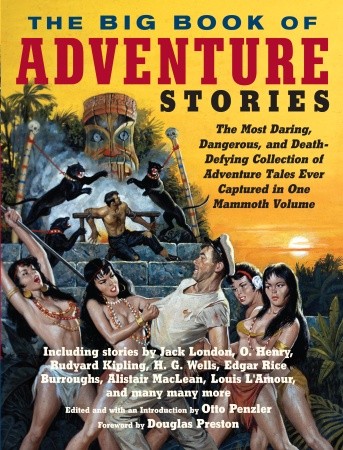
Actually, this first book is available now. I should have mentioned it earlier. Edited by Otto Penzler, The Big Book of Adventure Stories purports to be the largest and best compilation of adventure stories inside one cover. It certainly contains the top names of pulp and adventure fiction: Jack London, O. Henry, H. Rider Haggard, Alastair MacLean, Harold Lamb, Talbot Mundy, Cornell Woolrich, Baroness Orczy, Rafael Sabatini, Philip Jose Farmer, Sax Rohmer, Louis L’Amour, H.G. Wells, Clark Ashton Smith, Fritz Leiber, and Robert E. Howard. Whew!
Check out that table of contents: the story that introduced The Cisco Kid; a Zorro story; the complete Burroughs novel Tarzan the Terrible; "To Serve Man"; and the first appearance of Buck Rogers.
The Conan story selection is intriguing. "The Devil in Iron" is good, but "Iron Shadows in the Moon" is a better, similar story. Penzler is legendary in the field, so I am interested in reading his justification for choosing "Devil".
A second book I'm looking forward to is Conan the Barbarian: The Stories that Inspired the Movie. This is an official publication by Del Rey, publishers of the Howard trade paperback library. It's due for release at the end of July as a mass market paperback listed at 304 pages. I wouldn't expect it to be illustrated except for perhaps a frontispiece and a map. So far, the contents haven't been released. Knowing the page counts of the stories and the expected page count of the book, there's some good guessing of the contents going on at the official forum. If it does turn out to be a true "best of Conan" compilation, it should make a great inexpensive entry for first-time Howard readers.
I had planned for another post on my True20 Freeport campaign report for today but I'm still sorting through photos. I'll be working on that over the weekend.
In the meantime, check out this post over at Age of Ravens. Lowell traces the Japanese concept of mono no aware (the ephemeral nature of things) from the short life span of insects through to role-playing games. It's a look at how we remember those fleeting in-game experiences and how they live on in memory after their moment has passed.
What are some of your gaming memories--good or bad--that have stuck with you over the years?
Jean-Luc Godard was one of the leading filmmakers of the movement known as the French New Wave. The style and techniques used in Breathless (1960), his first feature, changed the landscape of cinema forever. As his career progressed, his politics tended to overshadow his technique. Along with Contempt (1963), Alphaville might be one of Godard's more conventional films.
American ex-pat actor Eddie Constantine found his niche portraying the private eye Lemmy Caution in a series of low-budget French crime films produced during the 1950s and early '60s, and based on the work of 1930s British writer Peter Cheyney. Even in other movies, the gruff, no-nonsense personality of the Lemmy Caution character carried over because of his popularity.
In true Godard fashion, Alphaville: A Strange Adventure of Lemmy Caution is a departure from the norm: an existential sci-fi noir/private eye film. Instead of Cold War Europe, the film finds Caution in a nebulous future era. He's sent by the Outer Countries to the technological "utopia" of Alphaville to find a missing scientist. Using his cover as a journalist, he makes his way through various levels of the bureaucracy (technocracy?), making contact with another undercover agent and falling in love with the scientist's daughter. That doesn't stop Caution from using her to get to the heart of Alphaville, the sentient computer Alpha-90. It's a battle of love and poetry versus the cold calculating logic of the machine that controls an entire population--and wants to expand that control to the Outer Countries.
I say "nebulous future", because it's unclear just exactly when or where the action takes place. Caution mentions being a veteran of Guadalcanal, which puts him in the post-war 20th century. He drives what looks like an early-'60s Mustang. The streets have other motor cars and buildings that would be at home in 1960s Paris, albeit futuristic modern architecture fitting the story.
However, there is the geopolitical question: what are the "Outer Counties"? Is "Nueva York" New York City? Where is Alphaville located? The weather and daylight are different from the north side to the south side. I like to think that it's an isolated island city-state in the middle of the Atlantic, based on the night scenes of driving to and from Alphaville, filmed on long streetlight-lit straight roads.
But then there is the talk about "galaxies". Lemmy's car is a "Ford Galaxy". Alpha-90 speaks about Caution traveling "light-years" across "open space". Caution is offered control of at least one "galaxy" in exchange for his cooperation. Because of the anachronistic mix of words and images, I believe that one possible reading of the film is that it's all a fever dream; it only exists in the mind of the Lemmy Caution from his other films, a nightmare brought on by the ever-increasing danger and loss of identity in the post-war atomic age.
I'm not sure that it really matters if the story is set on Earth or if Alphaville is another planet. Godard is playing with the conventions of the pulp/noir film drama, mixing in his own meditations of life, the meaning of art, beauty, and what it means to be human in an increasingly tech-driven consumer-focused society where the people move in circles and more words are removed from the "bible" (a dictionary) every day. It's very much in the same realm as other science-fiction dystopias as 1984, Brave New World, and films from Soylent Green to Blade Runner. It was also one of the inspirations for the name of this blog.
I watched Alphaville using streaming Netflix. The Criterion Collection released it very early on DVD (with only a liner notes essay, available online) although it appears to be out-of-print currently. I'm not sure if Criterion still the rights. If so, I hope they consider updating this title to a proper special edition on DVD or Blu-ray. Many of Eddie Constantine's other Lemmy Caution films are available from Sinister Cinema.
I mentioned before that I have been looking at systems to use for a Hyborian Age campaign eventually; something that matches up to the weird pulp fantasy feeling one gets when reading Howard (and Lovecraft, and Smith, and Leiber...).
D. and I were talking recently about Labyrinth Lord, and I also want to check out OpenQuest. I need to investigate the damage dice variation for Action Cards, too.
Now, another possibility: Stuart at Strange Magic will be following up on his excellent Weird West RPG with Weird Fantasy. So many good choices!
He certainly deserves more than just this brief posting, but I couldn't let the 100th anniversary of Vincent Price's birth go by without commemoration.
One of my favorite actors--and one of the greats from the second generation of horror movie icons, among such company as Peter Cushing and Christopher Lee (also born on May 27th). Price was born on this date in St. Louis, Missouri in 1911.
Cinema St. Louis has been celebrating this past week with their Vincentennial: exhibits of artifacts, artwork, lectures and presentations, and screenings of 20 Price films. Check out the program guide here.
I couldn't make it to the Vincentennial, but I could probably host a reasonable facsimile here in the Kaiju Lair with our collection of Price DVDs. I'll try to spin one over the holiday weekend--or check out a movie I don't have via streaming Netflix.
For the next few campaign wrap-up postings, I'd like to show some photos taken during the game. I'll also include scans of some maps and my notes. See the first part of my Shadows over Freeport wrap-up here.
March 2008: My gaming area after the character creation session and before the "official" first session. I added a four-foor table to the end where I sit to allow more room for the players and my notes and other items.
May 2009: The party fights their way through degenerate serpent people on the fourth level of the sunken Temple of Yig, buried under the volcanic rock of Mount A'Val. This location was taken from the module Madness in Freeport, the final chapter of The Freeport Trilogy.
Down to the fifth level of the Temple of Yig.
At the base of the temple, the sixth level, the group splits up to fight more degenerate serpent people in the corridor while others take on the awakened Avatar of Yig who had been sleeping in the sacrificial pit.
Another view of the battle. The worm miniature shown here is far below scale (so is the map); the Avatar was closer to 70 feet long. The d10 in the background marked the location of the only intact egg found in the hatchery.
1963 was a good year for Ray Harryhausen. One of his most popular films, Jason and the Argonauts, was in general release; he married his wife Diana; and pre-production started on his next film, First Men in the Moon.
In the late 1950s and 60s, studios produced many films that we could call "Victorian science-fiction adventure" -- Journey to the Center of the Earth, The Time Machine and 20,000 Leagues under the Sea are some examples. The advance of special effects techniques and widescreen Technicolor processes allowed filmmakers to realize these fantastic worlds on the screen in a realistic way as never before.
First Men in the Moon was a departure from other science fiction films of the era. Rather than an invasion of Earth by aliens, it documents the exploration of an alien civilization by human beings. Harryhausen was a fan of H.G. Wells' book and had wanted to bring it to the screen for some time (the last film production having been made in 1919) but was unable to convince his partner, producer Charles Schneer, that it could be done in a way that modern audiences would believe.
That changed when he mentioned the idea to British screenwriter Nigel Kneale (creator of the character Professor Quatermass). Kneale proposed the idea of a wrap-around story, in which a modern UN lunar mission finds a tattered Union Jack on the surface and a note claiming the Moon for Queen Victoria. Schneer signed Kneale on to co-write the screenplay.
Unlike most Harryhausen films there are only three instances of stop-motion animation: the caterpillar-like "mooncalf", a Selenite technician and the Grand Lunar, the leader of the Selenites. The majority of visual effects are models, camera effects, forced perspective, and optical-printing layers of mattes together. The majority of the insect-like Selenites are portrayed by children in costume (the same technique used later in The Green Slime).
First Men in the Moon is a fun movie. It's very much in the vein of other family adventure films of the era like Journey to the Center of the Earth. I don't recall ever seeing First Men... on TV growing up, certainly not as often as Journey... was shown.
I watched the 2002 DVD release. The print used for the DVD looks good, and is presented in anamorphic widescreen. The DVD also includes a photo gallery, trailers for First Men... and two Harryhausen Sinbad films, a three-minute featurette on the optical print/stop-motion process Dynamation, and the hour-long bio The Harryhausen Chronicles.
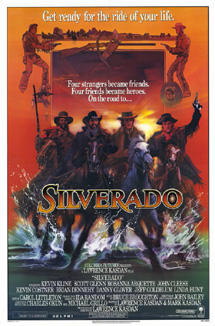
I had not seen Silverado until this past week. It was popular at the time of its release, particularly among the gaming and movie geeks I knew at the time. I just never got around to seeing it at the theater or on video.
After surviving a pre-credits ambush, ex-con Emmett (Scott Glenn) meets Paden (Kevin Kline) in the desert, left for dead by the bandits who stole his horse, hat and gun. They catch up with the bandits at a cavalry outpost, where they also encounter Cobb (Brian Dennehy), who used to run with Paden in earlier lawless days. Cobb offers Paden work, which he refuses. Emmett and Paden continue on to Turley to find Emmett's younger brother Jake (Kevin Costner) so they can both travel on to California. While in Turley they meet Mal (Danny Glover), an African-American gunfighter who left work in the stockyards of Chicago to find his family. Mal is thrown out of town by the sheriff (John Cleese) and the other three escape after busting Jake out of jail. The four of them find their way to Silverado where the son of the cattle baron Emmett killed in self-defense and Sheriff Cobb (something he forgot to mention to Paden earlier) control the town with intimidation and violence.
Lawrence Kasdan directed, produced and co-wrote the movie along with his brother. I wonder if there's a parallel between the Kasdan brothers and the characters of brothers Jake and Emmett: which one is the solid, steady loner, and which is the talented but wild and undisciplined one?
Kasdan had struck gold with several hit films before this. He completed the screenplay of The Empire Strikes Back with Leigh Brackett, wrote and directed Body Heat, wrote Raiders of the Lost Ark and Return of the Jedi, and wrote, directed and produced The Big Chill.
There seem to be two schools of thought among movie buffs concerning Silverado. One viewpoint holds that Kasdan works too close to the old line in the Western genre. The movie uses many of the classic Western movie cliches but doesn't do anything new with them. The second opinion is that it's Kasdan's adherence to these tropes that are its strength. Silverado is really one of the Last Great Westerns of the classic Hollywood studio era. There wouldn't be another major Western until Clint Eastwood's Unforgiven in 1992, which would then usher in a new round of Westerns including Tombstone and Kasdan's Wyatt Earp (again with Costner) in 1993.
I agree with the second viewpoint. It does use many classic Western tropes we have seen before but they are used here in a new way. Not in the revisionist way that we saw in Westerns of the 1970s--many of the Hollywood Westerns in the 1970s portrayed the End of the West as a historical idea but also as the End of the Hollywood System and the rise of independent filmmakers, heavily influenced by the spaghetti Westerns of Italy and Spain.
Silverado is a return to the ideas of the '40s, '50s and early '60s Hollywood Western. It's idealistic but not sappy, fun but not comedic. The events of the film and the obstacles put in the paths of our heroes are taken seriously by the characters (and by the film itself) even though there is still an optimistic tone that is reminiscent of the best classic Westerns. The difference is that here Kasdan is using a more modern method of storytelling that really became standard in Hollywood films at the end of the Eighties. We have multiple heroes with multiple storylines going at once and we see how these threads spread out and converge again. Kasdan uses classic filming shots and camera setups with a more modern story and editing style to create a new "old" Western. I understand the argument of its detractors, but the film has such heart and is such fun to watch. The four lead actors--most of them fairly early in their careers--really shine and work well together. I especially enjoy the fun and youthful Kevin Costner seen here, in contrast to the more serious demeanor he displays in much of his later work.
Silverado is also notable for the construction of the largest standing Western town set up to that time (later destroyed by fire during the filming of Will Smith's Wild Wild West, also co-staring Kevin Kline) which was re-dressed to portray both the towns of Turley and Silverado.
I watched Silverado using Instant Netflix. The menu screen suggests that it's in HD, although I couldn't tell if Netflix used a high-def transfer or the DVD transfer. The film is also available on 2-disc DVD and Blu-ray with several great extras, including a commentary track by Western historians.
It's been a little over two weeks since our Freeport campaign finished up. Freeport is Green Ronin's fantasy/pirates/Lovecraftian horror setting. The main book is systemless and GR has released or licensed rules companions for most of the major systems. We used GR's True20 system.
In total, we had sixty game sessions over three years and two months of real time. The final three sessions involved the party fighting a group of skeletal pirates at the bottom of the ocean, exploring a pyramid temple of serpent people on a sunken island while looking for the lost treasure of the legendary Captain Francisco, and fighting Deep Ones and their god who was imprisoned within the temple.
I'm still putting together my thoughts about the campaign. I think everyone enjoyed it. I often second-guess my game-mastering style, so I try to look over how the sessions went and what things I can improve on for the future.
Some ideas so far:
Talking with my hands: I tend to use my hands quite a bit when I talk. I hope that it isn't too distracting, but I'd like to cut down on it.
Speaking about the environment from my perspective: During this campaign, I noticed myself doing this and I tried not to make it a habit. When I describe a scene or location, I imagine it from the players' perspective and try to describe it as such. Unfortunately, I sometimes use directions from my point-of-view; that is, if I describe a tunnel to the left of the party, I would talk as if it was on my left--the opposite viewpoint of the party--which could get confusing for them. Perhaps even worse were the couple of times that I drew out maps on our miniatures grid mat facing me instead of the players.
Forgetting to use NPCs in combat: Often I found that I would forget about the allied NPCs that were with the party during combat. Usually I would have the NPCs take their actions before any of the group's adversaries. Missing their turns was never a determining factor in any of the combats so it wasn't an important issue but it could have lead to more interesting scenes. In my defense, one of my general guidelines is that NPC allies should never upstage the player characters.
Spending time looking up obscure rules: Part of this campaign's purpose was to try out True20, kick the tires and see how it works under actual play conditions. I'm still thinking about that and how it went. What I'd like to avoid is spending valuable time checking rules. At its heart, True20 is simple: roll a d20, add an attribute, and roll against a target number. With the additions of the Companion book, the Freeport Companion, the Bestiary, and the Handbooks for each of the three classes, there were some occasions where it became necessary to look something up. I was often torn between wanting to get the rules right and making a temporary ruling so that play would not slow down.
Not enough detail vs. too much detail: This is a tricky one. I tried to add enough detail to descriptions to make the campaign world seem real but without overwhelming the players with detail that wasn't significant to the game. I can recall describing some less-important NPCs with only the barest details.
These are only a few items that I've been thinking about. I'm sure I'll come back to this later. The next post about the Freeport campaign will have some photos of miniatures, maps and terrain from various important scenes. I also want to post some scans of my notes, charts and other notebook jottings.
I've been meaning to do this for some time now: I converted the majority of static links on my gaming blog list to an auto-updating blogroll. You'll find it at the bottom of the left sidebar. It's not complete so I'll be adding more as time goes on.
To new (and current) followers of the blog, thank you! I hope you find what I post here interesting and useful.
Reptilicus is a bizarre little movie. It's no wonder that clips of the monster were used as stock footage during the more chaotic moments on The Monkees' television show. Being the only Danish giant monster film, it was quite popular in its home country. I do remember it being shown on TV quite a bit when I was a kid, although I only remember seeing it fully once or twice. I remember it mostly from those clips on The Monkees.
High about the Arctic Circle (in a sunny tree-filled forest), a group of copper miners collect core samples from below the permafrost. The drill bit comes back up with thick leathery flesh caught in the threads... and fresh blood. Scientists from the Danmarks Aquarium are sent to inspect and dig up the fossil--or whatever is down there. They find part of a giant prehistoric reptile's tail. Keeping the sample frozen, they ship it back to the aquarium for study. The freezer door is left open one night, and it's discovered that the thawing tail is still alive and regenerating. Later, two UN representatives join them: a stern US brigadier general and a beautiful female scientist from UNESCO. Just in time, too, as the combination of increased nutrient flow and an electrical storm cause the regeneration to rapidly accelerate...
The real-life drama behind the making of the film is perhaps more entertaining than the movie itself. American producer/director Sid Pink developed the idea for the story, and co-wrote the screenplay with novelist and screenwriter Ib Melchior (who was born in Copenhagen). Pink set up production for the film in and around Copenhagen. The original version was filmed in the Danish language by Danish director Poul Bang and released there in 1961.
Pink directed the English version for American-International Pictures--twice. The first English version was filmed with many of the same actors, none of whom spoke English. They recited their lines in English phonetically. The execs at AIP, particularly Sam Arkoff, hated it. They had the film re-cut, with American voice actors dubbing the lines in English. They still had to match the stilted mouth movements of the Danish actors, however.
Several scenes and parts of scenes were cut for the AIP release, including the infamous Reptilicus flying scene (or this link). It's set at night so the crude nature of the effects work isn't as obvious. Compared to the rest of the creature effects in the movie, the flying scene really isn't that bad. The model for Reptilicus itself appears to be a marionette puppet.
One aspect of the film that was kept is the inclusion of popular Danish comedian Dirch Passer. He plays the night watchman hired on to keep an eye on the frozen Reptilicus tail in the aquarium. His scenes are played for laughs, of course. The officer he talks to at the police station was one of his frequent comedy collaborators.
For the AIP release, Reptilicus' green acid slime spit was added. This takes the form of hand-drawn animation added into scenes where the monster attacks crowds at the beach or on the streets of Copenhagen. Apparently many, many locals were used for the crowd scenes, and members of the Danish military and their equipment were provided for the films use. These scenes and the stock footage are carefully edited together. It's really not bad at all for a lower-budget production. And, as previously noted, it was a source of pride for the Danish people.
Before the monster attacks, the American general accompanies his Danish counterpart and the UNESCO representative for a drive and a night on the town. This part seems almost as if someone slipped a tour package film into this monster movie. For someone who seemed to hate his new assignment at first, the brigadier general now appears to know all about the history, architecture and public sculpture of Copenhagen.
I watched the out-of-print Midnite Movies DVD from MGM. The print used is in decent shape, considering the history of the film. The film was shot in 1.37:1 35mm, so the DVD is full screen and non-anamorphic. You can also watch the 10-minute version. For more details, I recommend the reviews and background at Jabootu's Bad Movie Dimension or The Monster Shack. It's goofy fun, and really inspires the viewer to provide an ongoing MST3K-style commentary.
Update 2: Shout Factory released a four-movie Sci-Fi Classics disc in September 2013 including Reptilicus, presumably using the same print as the MGM disc.
Update 3: Scream Factory, a sub-label of Shout Factory, will release a Blu-ray double-feature of Tentacles (1977, also previously released in the Midnite Movies series) and Reptilicus on June 16th, 2015.
Update 4: Reptilicus is the experiment for the first episode of Mystery Science Theater 3000's 11th season, now streaming on Netflix (listed as Season One).
The first theatrical trailer for Conan was released into the wilds of the internet yesterday. I'll have more to say about it later after I've watched it a few more times. I will say that, based on just one viewing, I'm slightly more encouraged about the film than before.
There's some talk that this trailer will be attached to Thor when it's released this weekend. If not, it should be.
Loud speakers warning: the video starts playing as soon as the page loads up.
Joseph Kuo was one of the leading independent directors of Hong Kong kung fu movies. Mystery of Chess Boxing, Blazing Temple and 7 Grandmasters are considered his best work. Before those films, one of his early successes was 18 Bronzemen.
Set during the Manchu invasion, 18 Bronzemen opens with an attack on the household of a notable Ming general. The general is killed, and his infant son Shao Long is passed into a family of Ming loyalists, where he begins kung fu training and brutal beatings to give him strength. The Manchu continue to terrorize the surviving Mings, and so the boy is sent to the safety of the Shaolin Temple for further training. Before his training can be considered complete he must pass through the 36 Chambers and face the 18 Bronzemen, or die in the attempt...
This was one of several kung fu films to focus on the Shaolin Temple and the 36 Chambers of testing in particular, two years before Lau Kar-Leung's famous The 36th Chamber of Shaolin. The success of this film would lead to two sequels (well, same actors, different characters...): Return of the 18 Bronzemen and the aforementioned Blazing Temple (8 Masters). Carter Wong (Thunder from Big Trouble in Little China) plays the "big brother" role, the serious student who helps the bumbling Shao Long through his training.
For an independent film of the time, the production quality is fairly high. The sets of the Temple, especially the training areas, are impressive. The town setting must have been filmed at one of the studio backlots, but is very effective, and the teahouse fight scene is really good. Carter Wong's fight scenes are the highlight of the film.
One lingering question: What are the 18 Bronzemen? Automatons? Shaolin masters in gold paint?
The first two-thirds of the movie--involving the Temple and the training--work the best. Once they leave, the film starts to fall apart. It's almost as if it's rushing to move the story along. The editing of some scenes can leave the viewer wondering who people are and what is going on. I think that's a problem both with the dubbing and with cultural differences. When Polly Shang first appears, it is implied that she is disguised as a man and Shao Long is fooled by the disguise, although to the viewer it's obvious that she isn't. I got it, that it's a cultural convention for these types of stories, but the casual viewer might take it literally. There's also one of the worst jump-cuts I've seen in a kung fu film, where the fight between our heroes and the Manchu warlord goes from a city street to a mountain valley in one cut.
Odd story and editing choices aside, the film is worth seeing as a great example of the independent kung fu films outside the major studios (i.e., Shaw Brothers) and the early "old-school" productions.
I watched the Tai Seng/Mei Ah DVD released in 2002 with Mandarin dialogue and English subtitles. It can also be viewed in 10-minute parts on YouTube.
I haven't been keeping up with DVD release news for about five weeks now, so -- wouldn't you know it? -- that's the time when there are some big announcements.
Hammer fans can now get the DVD of The Creatures the World Forgot from Sony's Screen Classics Manufactured-On-Demand series. The last of the three prehistoric epics from Hammer (including One Million Years B.C. and When Dinosaurs Ruled the Earth), Creatures... is notable for the near-total lack of dialogue. The story is told through the actions of the characters (no stop-motion dinosaurs, either). It was released on VHS years ago but has only been available recently as a download or streaming rental through Amazon Video on Demand.
The Warner Archive continues rolling out great films from the vault through their MOD program. One of the latest releases is the Rankin/Bass-produced film The Last Dinosaur, which has special effects by Tsuburaya Productions. From the IMDB:
Science has announced the discovery of a lost land hidden inside the warm pocket of a dormant volcano under the polar ice cap. Masten Thrust, a billionaire oil tycoon and big-game hunter, is recruited to lead a team there to study the last living dinosaurs. Upon arriving, Thrust and his team find that the hidden world is populated with both dinosaurs and prehistoric humans. While the humans give the explorers a fair bit of trouble, the real danger is the hungry tyrannosaur intent on making lunch out of the Great White Hunter and his crew.
This was originally planned as a theatrical release but was shown in the US as a TV-movie. I only remember vague mentions of this; I don't believe I ever saw it on TV.
Speaking of MOD discs, Sony has made an agreement with Warner Brothers to sell their Screen Classics on Demand from the Warner Archive web store. It makes sense -- Warner Archive has become the MOD powerhouse among the studios and (even better) Warner Archive has regular sales and coupon codes. MGM's own foray into the made-on-demand business had some false starts with Amazon, although it appears that MGM MOD discs are being made available now through Screen Archives Entertainment, the fine folks who bring us Film Score Monthly limited edition soundtrack CDs and other treasures.
Legend Films has released various movies from the Paramount back-catalog, and on May 3rd we get an excellent British horror treat: a Blu-ray double-feature of Hammer's The Man who Could Cheat Death and Amicus Productions' The Skull. Legend released these two on DVD previously. Severin Films has Amicus' The House That Dripped Blood in prep for eventual release.
Public domain-content provider Film Chest has restored and released Roger Corman's 1963 film The Terror as a Blu-ray/DVD combo pack. The movie was made in a matter of days using the magnificent sets left over from Corman's Poe film The Raven, and extra time left on Boris Karloff's contract. It's impressive considering the circumstances of the shoot. I have a soft spot for The Terror, as I remember it being a staple of Saturday afternoons as a kid. If one of the Corman Poe films were being shown, it was likely to be The Terror -- probably due to its public-domain status. With this high-def release it gets the restoration it deserves.
Finally, there has been some buzz about an official DVD release of Godzilla vs. Megalon. As with The Terror, Megalon has been a mainstay of public-domain releases. Nearly every PD video company put out a cheap VHS tape during the '80s and '90s. So far it appears to be speculation. I'm sure there is more to the story, and like many others I hope we see an official release soon.


 PDF